For most nationalities, the honest answer is yes, but it's a straightforward one. You'll need a Visa on Arrival, and for most travelers it takes minutes rather than hours to sort out.
Where people tend to get anxious is the noise around it, conflicting blog posts with different numbers, and recent headlines about possible new financial checks that aren't actually in effect yet.
This guide lays out what's currently required, sourced against Indonesia's official immigration information, and separates that clearly from what's still just a proposal.
Visa policy is one of the few travel topics that can genuinely change with little notice. Everything below reflects the official position as of the date at the top of this article. Always cross-check against the official immigration site (imigrasi.go.id) before you book, especially if you're reading this more than a few months after publication.
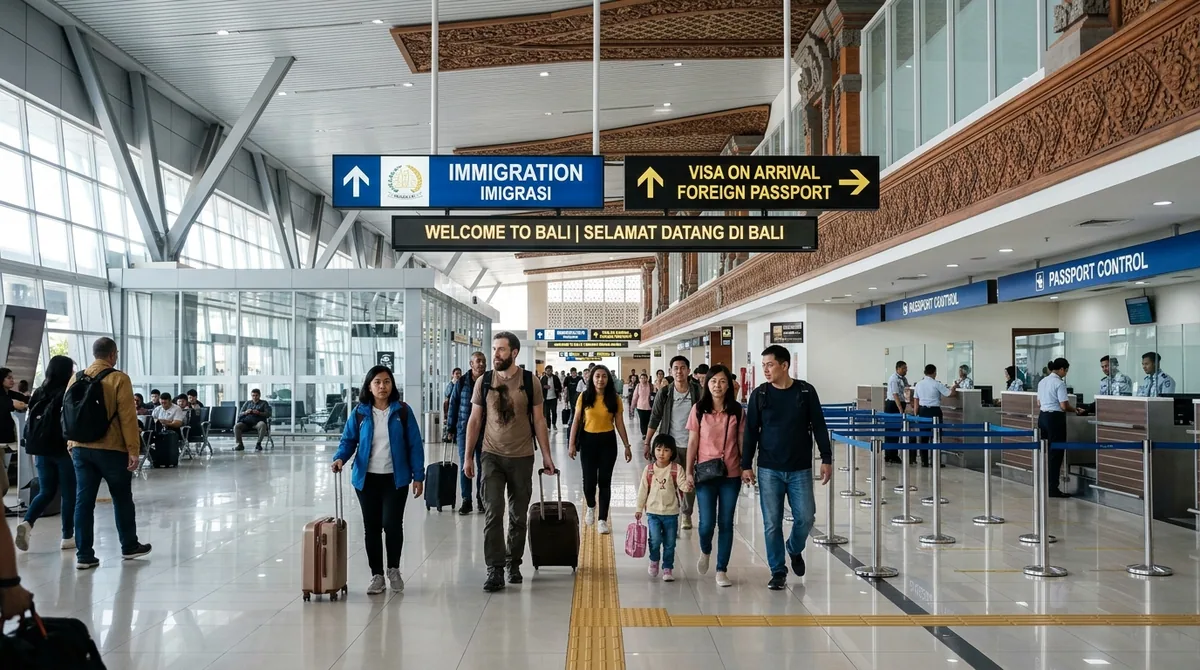
The Short Answer: Visa on Arrival (VOA)
Most visitors, including travelers from the United States, Australia, the United Kingdom, and most of Europe, enter Bali on a Visa on Arrival, sometimes shortened to VOA.
It grants an initial 30-day stay, extendable once for a further 30 days, for a maximum stay of 60 days. The official government fee is IDR 500,000, payable in Indonesian Rupiah or several major currencies at the airport counter.
There are two ways to get it: pay at the counter on arrival, or apply online in advance through e-VOA, which is generally faster since it skips the payment queue in the arrivals hall.
One crucial detail that frequently trips up first-time travelers is how Indonesia counts your 30 allowable days. Your date of landing counts as Day 1, regardless of whether your flight touches down at 10:00 in the morning or 11:45 at night. Likewise, your date of departure counts as a full day. Misjudging this calendar math by even a few hours leads to an official overstay fine, currently assessed at IDR 1,000,000 per day per passenger. If your planned trip borders exactly around the one-month mark, calculate your flight arrival and departure dates meticulously.
Who Is Eligible
As of the current regulation, 97 countries are eligible for Visa on Arrival, including the United States, United Kingdom, Australia, Canada, New Zealand, Japan, South Korea, China, India, and all European Union member states.
This list is set and periodically updated by Indonesia's Directorate General of Immigration, so if your country isn't in the examples above, it's worth checking the official list directly rather than assuming either way.
Citizens of ASEAN countries have a separate, simpler arrangement: visa-free entry for up to 30 days, with no fee and no application needed.
The 10 ASEAN member nations eligible for this 30-day visa exemption include Brunei Darussalam, Cambodia, Laos, Malaysia, Myanmar, the Philippines, Singapore, Thailand, Vietnam, and Timor-Leste. However, an essential caveat applies: this visa-free entry cannot be extended under any circumstances while inside Indonesia. If you enter on an ASEAN visa-free stamp and wish to stay longer than 30 days, you must exit Indonesia or apply for an extendable tourist visa beforehand.
Bali Entry Visa Types & Eligibility at a Glance
| Entry Category | Eligible Nationalities | Initial Stay | Extension Rules | Official Fee |
|---|---|---|---|---|
| Visa on Arrival (VOA / e-VOA) | 97 Countries (US, UK, AUS, EU, CA, etc.) | 30 Days | Extendable once (+30 days, max 60) | IDR 500,000 (~USD 32) |
| ASEAN Visa-Free Exemption | 10 ASEAN Member Nations | 30 Days | Strictly Non-Extendable | Free (IDR 0) |
| C1 / 211A Visit Visa (Advance) | Non-VOA nationalities or longer stays | 60 Days | Extendable up to 180 days total | IDR 1,500,000 - 2,000,000 |
e-VOA vs Airport Counter
Both options cost the same and grant the same 30-day stay, so the choice really comes down to convenience.
e-VOA (applied for online in advance) lets you pay before you travel and generally means a faster path through arrivals, since you're not queuing to pay on the spot. This tends to matter more on late-night flights when arrival halls are busiest.
Counter VOA (paid on arrival) works fine too, and remains a common choice, particularly for travelers who prefer not to deal with anything before departure. Just budget some extra time at the airport, especially during peak hours.
This is also where the two options genuinely diverge: e-VOA holders can use Ngurah Rai's biometric autogate lanes, a scan-your-passport, face-recognition process that typically takes well under a minute. Counter VOA still means the standard manual immigration queue, which can run considerably longer during busy arrival windows.
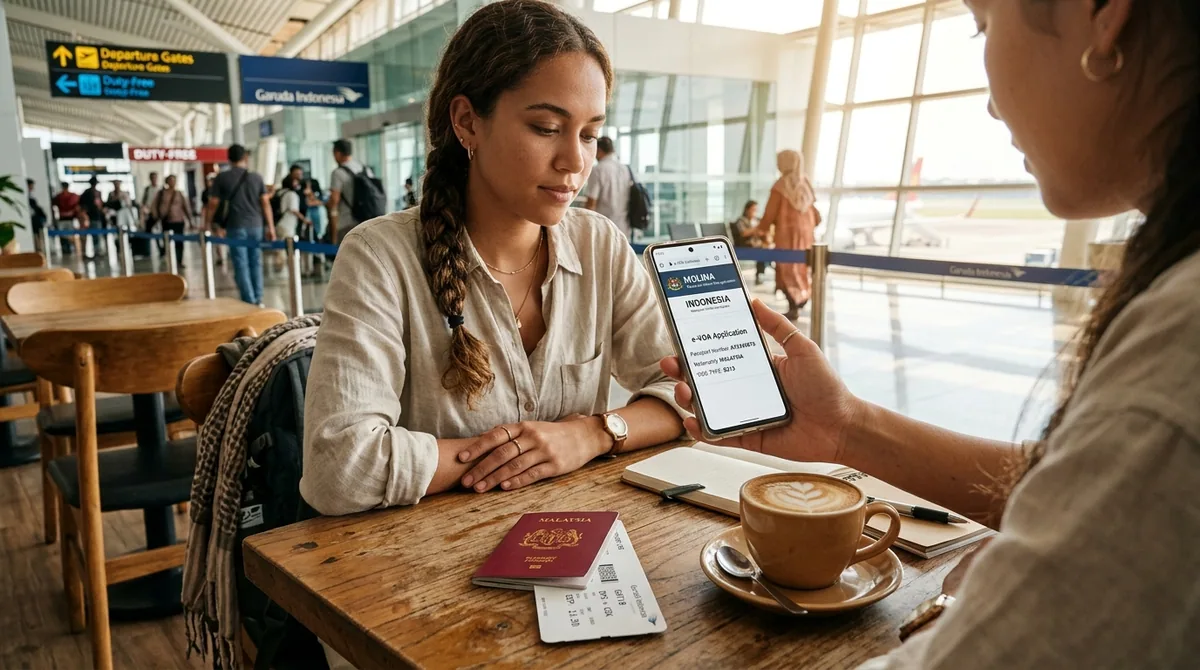
The autogate installation at Ngurah Rai International Airport represents one of the biggest upgrades to Bali travel in recent years. Dozens of automated biometric gates now stand alongside manual officer desks. Travelers with an approved e-VOA linked to their electronic biometric passport simply approach the gate, place their passport bio page face down on the scanner glass, look straight into the overhead camera for a rapid facial recognition check, and the glass barrier opens automatically in roughly 20 to 30 seconds. No stamps, no physical sticker in your passport, and no waiting in queues behind 200 fellow passengers from a widebody flight.
In contrast, travelers opting for Counter VOA must first queue at the Bank Rakyat Indonesia (BRI) payment booth to pay their IDR 500,000, receive a paper receipt and visa voucher, and then line up a second time at the conventional manual immigration counters to have the sticker pasted and stamped by an immigration officer. During mid-afternoon and late-evening arrival rushes when multiple flights from Sydney, Melbourne, Singapore, and Doha land simultaneously, this two-step process can easily add 30 to 60 minutes to your arrival experience.
e-VOA Online vs Counter VOA at Ngurah Rai Airport
| Comparison Aspect | e-VOA (Online in Advance) | Counter VOA (Airport Arrival) |
|---|---|---|
| Application Window | Online 48 hours to 14 days before departure | Upon landing before immigration desks |
| Payment Method | Online credit/debit card (Visa, Mastercard, JCB) | Airport payment counter (Cash IDR/AUD/USD or Card) |
| Immigration Gate Access | Biometric Autogates (under 60 seconds) | Manual Immigration Desks only (15 - 60 min queue) |
| Official Government Cost | IDR 500,000 (+ small online payment gateway fee) | IDR 500,000 (flat rate) |
| 30-Day Extension Process | 100% Online extension via Molina portal | Requires physical visits to Kantor Imigrasi in Bali |
Documents You'll Actually Need
Beyond the visa itself, a short list of standard documents covers most of what's checked on arrival.
- A passport valid for at least six months from your arrival date.
- Proof of onward or return travel, typically a return flight ticket.
- Proof of accommodation for your stay in Bali.
- A completed All Indonesia digital arrival form, submitted online within a few days before landing, with the resulting QR code ready to show.
Separately from the visa itself, Bali applies a tourist levy of IDR 150,000, payable online in advance or at counters on arrival, which funds environmental and cultural preservation programs on the island.
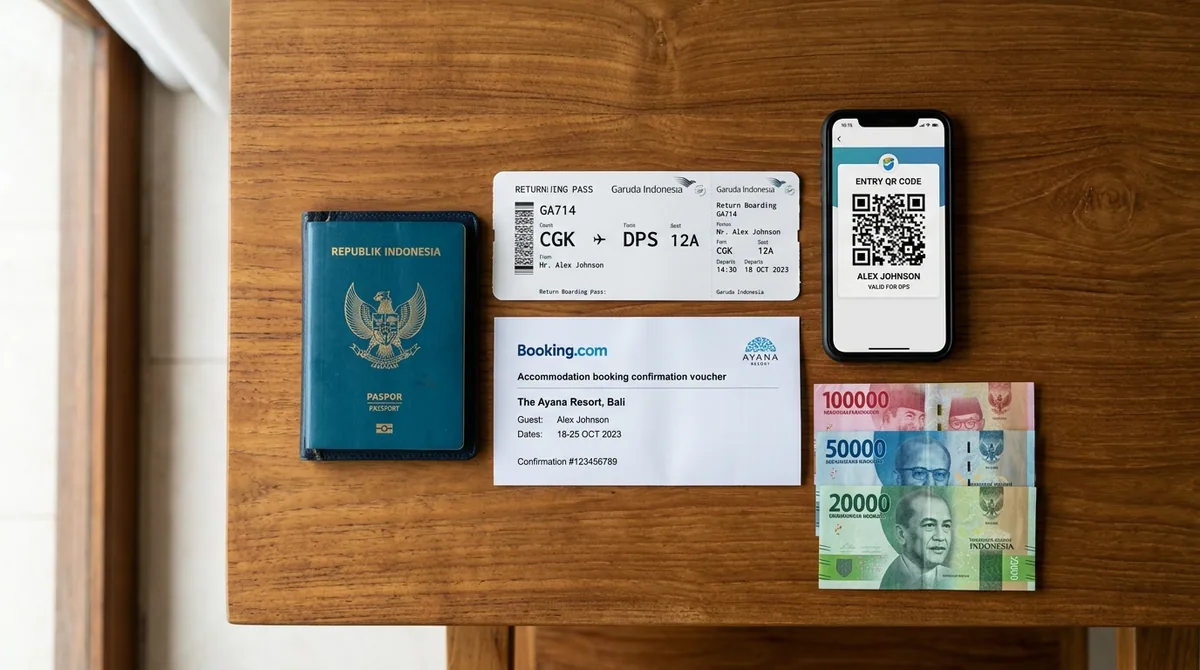
Let's unpack each of these requirements so there are no surprises when you land:
1. The 6-Month Passport Rule: This is non-negotiable. Indonesian immigration and airline gate agents strictly enforce having at least six months of remaining validity on your passport counted from the date of your landing in Bali. Furthermore, ensure you have at least two completely blank visa pages for entry stamps if you are not using autogates.
2. Return or Onward Ticket: Airlines departing for Indonesia will routinely refuse boarding at your home airport if you cannot display a confirmed outbound flight ticket leaving Indonesia within your allowable 30-day or 60-day visa period. An open ticket or a vague reservation itinerary is rarely accepted.
3. Proof of Accommodation: You should have at least your first few nights of accommodation confirmed, whether that is a hotel booking confirmation, a private villa rental receipt, or a homestay voucher with a clear physical address in Bali.
4. Electronic Customs Declaration (e-CD): Indonesia has completely phased out paper customs forms. All international travelers must complete the official electronic customs form online (at ecd.beacukai.go.id) within 72 hours before their flight touches down. Completing it takes roughly three minutes, and generates a single QR code per family traveling together, which you scan at the customs checkpoint right after collecting your checked baggage.
5. Bali Tourist Levy (Love Bali): Implemented by the Provincial Government of Bali, this IDR 150,000 (roughly USD 10) regional fee is dedicated to funding island waste management infrastructure, preserving Balinese cultural heritage, and enhancing road safety. You can pay it in advance via the official Love Bali website (lovebali.baliprov.go.id) or mobile app, which issues a digital voucher with a QR code to present upon arrival.
About the "Proof of Funds" Headlines
If you've seen news coverage about Bali possibly requiring three months of bank statements from tourists, here's the accurate, current picture.
What's already true: longer-stay visa categories, such as the 60-day C1 Visit Visa, already require proof of funds, generally around USD 2,000 along with recent bank statements. This isn't new and isn't specific to Bali.
What's being proposed, not yet in effect: Bali's provincial government has been developing a "Quality Tourism" regional regulation that would allow discretionary financial checks on standard Visa on Arrival travelers too, essentially giving immigration officers the option to request proof of funds on a case-by-case basis rather than as a universal requirement.
As of the most recent information available, this remains a draft regulation working through Bali's regional legislature, with no confirmed enactment date. It has not applied uniformly to VOA travelers at the time of writing.
What this means practically: the standard 30-day VOA currently does not require proof of funds as a routine document check. That said, since immigration officers generally retain discretion to ask questions about a traveler's ability to support their stay, keeping basic financial documentation accessible during your trip is a reasonable, low-effort precaution regardless of whether this specific proposal is formally enacted.
Given how fluid this particular policy area has been, this is exactly the kind of detail worth re-checking closer to your travel date rather than relying on any single article, including this one.
The mandatory requirement for 3 months of bank statements (minimum USD 2,000) applies specifically to pre-arranged long-stay visitor visas like the 60-day C1 visa. Standard 30-day VOA tourists are NOT routinely subjected to bank statement checks upon arrival.
About the Proposed Fee Increase
One more development worth flagging with the same care as the funds-check proposal above. In August 2026, Indonesia's Director General of Immigration publicly proposed raising VOA fees, to IDR 750,000 for e-VOA and IDR 1,000,000 for counter VOA, up from the current IDR 500,000 flat rate.
The stated reasoning was twofold: adjusting for rupiah exchange rate fluctuations, and encouraging more travelers to apply online in advance rather than at the counter, which is also why the proposal splits the price by application method.
As of the most recent information available, this remains a proposal without a confirmed effective date. Indonesia's official immigration channels were still listing IDR 500,000 at the time of writing. Given the specificity of the numbers already circulating, it's worth checking the official immigration site for the current rate shortly before you book, rather than assuming either the old or new figure applies by default.
Extending Your Stay: How the 30-Day VOA Extension Works
If you arrive on a standard 30-day Visa on Arrival and fall in love with the island, you can extend your stay once for an additional 30 calendar days, bringing your total allowable stay in Indonesia to 60 days. How you accomplish this depends completely on whether you chose e-VOA or Counter VOA initially:
If you entered via e-VOA: The extension process is seamless and digital. You log in to your account on the official Molina portal (evisa.imigrasi.go.id), locate your active visa under your dashboard, click 'Extend', pay the IDR 500,000 fee via credit card, and the extension is granted electronically. You never have to step foot in a government office or surrender your passport.
If you entered via Counter VOA: The extension requires a physical process through one of Bali's three immigration offices (Kantor Imigrasi Ngurah Rai in Jimbaran, Kantor Imigrasi Denpasar in Renon, or Kantor Imigrasi Singaraja in North Bali). This traditionally involves three separate visits: first to submit paperwork and surrender your original passport, a second visit 3 to 5 business days later for biometric digital photos and fingerprints, and a third visit to collect your stamped passport. Many travelers choose to pay a reputable local visa agent (roughly IDR 800,000 to IDR 1,200,000) to handle the paperwork trips, so they only need to show up once for fingerprinting.
Regardless of which method you use, always initiate your extension at least 7 to 10 days before your initial 30 days elapse. Waiting until the final 48 hours risks processing delays that can push you into unintentional overstay penalties.
Planning Around Your Visa Dates
Once your visa situation is sorted, the more useful planning question becomes what to actually do with your time in Bali.
A 30-day VOA comfortably covers most trip lengths, but if you're planning something closer to two or three weeks, having a rough shape for your days helps avoid the common trap of spending half the trip figuring out logistics instead of seeing the island.
Our Bali itinerary guide breaks down sensible day-by-day structures for different trip lengths, useful whether you're working with a tight week or the full 60-day extended stay.

For travelers visiting for 7 to 14 days, splitting your base between two distinct regions—such as pairing the tranquil cultural center of Ubud with the dramatic coastal cliffs of Uluwatu or the laid-back snorkeling bays of East Bali—delivers a diverse and unhurried holiday. Trying to commute back and forth across southern Bali's traffic corridors every single day burns valuable vacation hours that could otherwise be spent watching the sunset from a cliffside temple or walking among emerald rice terraces.
Who Should Pay Extra Attention to Visa Rules
Visa requirements affect every visitor, but a few groups benefit from double-checking the details more carefully than others:
- Travelers from countries not commonly listed in general blog examples, since eligibility genuinely varies and shouldn't be assumed.
- Anyone planning a stay longer than 30 days, who'll need to factor in the extension process or a different visa category entirely.
- Digital nomads or remote workers, since a standard tourist VOA doesn't cover paid work, even work for a foreign employer, and a separate visa category exists for that purpose.
Navigating transportation seamlessly right from your airport arrival makes settling into Bali much easier. Reserving a dedicated airport transfer or booking an experienced Bali private driver ensures you bypass aggressive taxi touts at Ngurah Rai and travel directly to your hotel in air-conditioned comfort. For travelers interested in structured sightseeing across the island, our comprehensive Bali tour packages catalog offers flexible day trips tailored to your personal schedule.
Frequently Asked Questions
How much does a Bali Visa on Arrival cost in 2026?
The official fee is IDR 500,000, whether you apply through e-VOA in advance or pay at the airport counter on arrival.
Do I need to show proof of funds to enter Bali right now?
Not for the standard 30-day Visa on Arrival, as of the date of this article. A separate proposal that could add discretionary financial checks has been discussed but was not yet formally enacted at the time of writing, so it's worth verifying current status closer to your travel date.
How long can I stay in Bali on a Visa on Arrival?
An initial 30 days, extendable once for another 30 days, for a maximum total stay of 60 days.
Is e-VOA better than paying for the visa at the airport?
For most travelers, yes. Both currently cost the same and grant the same stay, but e-VOA holders can use the biometric autogate lanes at Ngurah Rai, while counter VOA still means the standard manual queue.
Final Thoughts
For the large majority of travelers, getting into Bali comes down to a straightforward IDR 500,000 Visa on Arrival, a handful of standard documents, and a digital arrival form filled out shortly before landing.
The proof-of-funds proposal making headlines is worth being aware of, but as it stands, it isn't a routine requirement for the standard tourist visa, just something worth a quick re-check closer to your travel date given how actively it's being discussed.
Once the entry side is handled, the more enjoyable planning starts, and that's where Bali Nusa Tour comes in, helping travelers turn their visa-length stay into a well-structured, unhurried trip around the island. Whether you need reliable airport pickup, custom day excursions to hidden waterfalls, or a multi-day private itinerary, our local Balinese drivers ensure you experience the very best of Bali with zero hassle.
Arrive Confidently & Tour Bali with Local Guides
Skip airport taxi chaos and explore Bali comfortably with trusted local drivers. Private air-conditioned vehicles, transparent daily rates, and personalized itineraries.
Chat with Us on WhatsApp